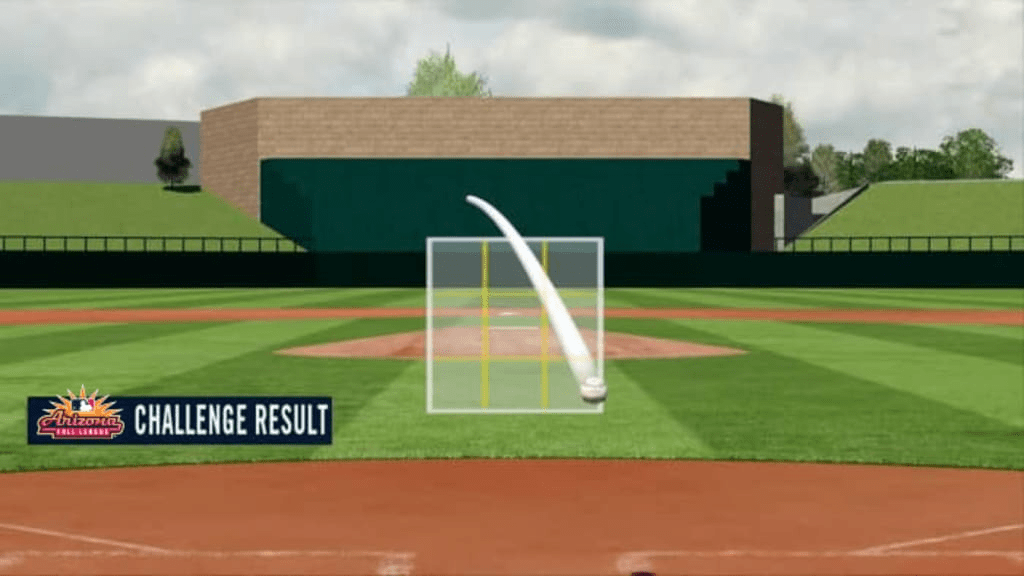
Are you tired of your favorite baseball team losing because of a bad call from the home plate umpire? The Automated Ball-Strike System (ABS) may come to Major League Baseball as soon as the 2026 baseball season. The Automated Ball-Strike System has been researched and studied in various leagues such as the Atlantic League of Professional Baseball.
The Atlantic League of Professional Baseball, an independent baseball league and partner of Major League Baseball, adopted the automated strike zone in 2019 so that it could be used as a trial run for the potential of being in Major League Baseball. How did it work in the Atlantic League of Professional Baseball? An umpire would wear an Apple AirPod in one ear. Once the AirPod is placed in the umpire’s ear, the system will then connect to the press box. A small panel would then be placed either just above home plate on the net or just above the press box, but would be set up above home plate to ensure accurate calls.
Per the MLB rule book, “A small panel is placed in an elevated position behind home plate, and it makes its rulings based on “that area over home plate the upper limit of which is a horizontal line at the midpoint between the top of the shoulders and the top of the uniform pants, and the lower level is a line at the hollow beneath the kneecap.”
Players in the Atlantic League of Professional Baseball are not affiliated with any MLB organization because it is an independent league. This means that players play in the Atlantic League with the hopes of getting their contract selected and signed to an MLB organization. As part of the deal for the Atlantic League of Professional Baseball, MLB agreed to send more scouts to their games to give the players more of an opportunity to get signed to an MLB-affiliated contract.
Six years later, the thought of adding the Automated Ball-Strike System is discussed more than ever. Major League Baseball umpire Angel Hernandez retired in the middle of the 2024 baseball season. An umpire career filled with controversy, the fans most criticized him, players, and coaches for his umpiring behind the plate. As 2025 approaches the end of its season, it is becoming increasingly clear that fans would prefer the automated strike zone. One of the big questions that has been circling is how much it will take away from the game. Another question is, will the system slow the game down dramatically?
The ABS System used this spring training and at the All-Star Game is measured by using HawkEye technology, which is a software system that tracks data from ball data to swing data to player movement data.
During the 2025 Spring Training, Major League Baseball tested out the ABS in 13 different ballparks across both the Cactus League and the Grapefruit League. Each team during the games was granted two challenges. The challenge would work as follows: if the batter or pitcher felt that the umpire got the call behind the plate incorrectly, the batter or the pitcher would tap on their helmet or their hat to challenge the call. If the challenge is not successful, the team would then lose a challenge.
“I think the Automated Ball-Strike System (ABS) with challenges will be good, but I still like the human umpire there, too. It adds to its authenticity,” said Theo Buffered, a baseball fan. Ben Gottessman said, “If implemented properly, robot umpires could make the game more fair and consistent, which is great for the integrity of the game. But MLB would need to balance the tech with the human side of the sport.”
Not everyone agrees with the ABS. A fan who wanted to remain anonymous said, “We need to keep baseball where it is right now. We already have the replay system, which is great, but baseball needs to remain authentic to its past when the greats like Babe Ruth and Mickey Mantle played. They did not have the luxury of the replay system or the ABS, so why should the players now have that luxury?”
It is still up in the air whether Major League Baseball will implement the Automated-Strike Ball system, but more research is needed to determine if it will be in the best interest of the sport.
 Jason Hochberg